Megan Judge HEXACO Psychology Results

Personality · Domains · Facets

HEXACO Personality Inventory

Six lexical factors, four facets each, plus an interstitial Altruism scale — visualised with population bell curves and the official scale descriptions from the University of Calgary.

About the Test

HEXACO at a glance — where to take it, what the six factors mean, and how the revised inventory differs from the original.

The model

6 domains, 24 facets, 1 interstitial scale

The HEXACO model adds Honesty-Humility to the familiar Big Five structure, splits Agreeableness into cooperation versus anger, and reframes Neuroticism as Emotionality. Each of the six factors has four facet-level scales (24 traits) and a 25th interstitial facet, Altruism (versus Antagonism), which cuts across Honesty-Humility, Emotionality, and Agreeableness.

Note

Reading psychometric results

Be aware you likely have the Dunning-Kruger effect on psychometrician vocabulary. If you get your psychology knowledge from the general public, mainstream media, or social media you have been pre-warned that you may misconstrue results. So just be careful is what I am suggesting.

History

From HEXACO-PI to HEXACO-PI-R

Construction of the HEXACO Personality Inventory began in 2000. The aim was to assess the six personality dimensions found in lexical studies across languages, and to reflect Ashton & Lee’s theoretical interpretations of those factors. By 2002, a provisional 108-item version was in use — six scales of 18 items each, without separate facet subscales.

The HEXACO Personality Inventory-Revised (HEXACO-PI-R) introduced two key changes. Within Extraversion, the Expressiveness facet was replaced by Social Self-Esteem. The interstitial Negative Self-Evaluation scale was removed. The PI-R now assesses four facets within each of the six factors, plus the interstitial Altruism scale — 200 items in the full HEXACO-200, or 100 items in the half-length HEXACO-100.

When computing the six factor scores, Altruism items are not included. If factor scores are computed as principal components, the Altruism scale can be included with the other 24 facets — it generally divides its loadings between Honesty-Humility, Emotionality, and Agreeableness.

Scoring

Reading your results

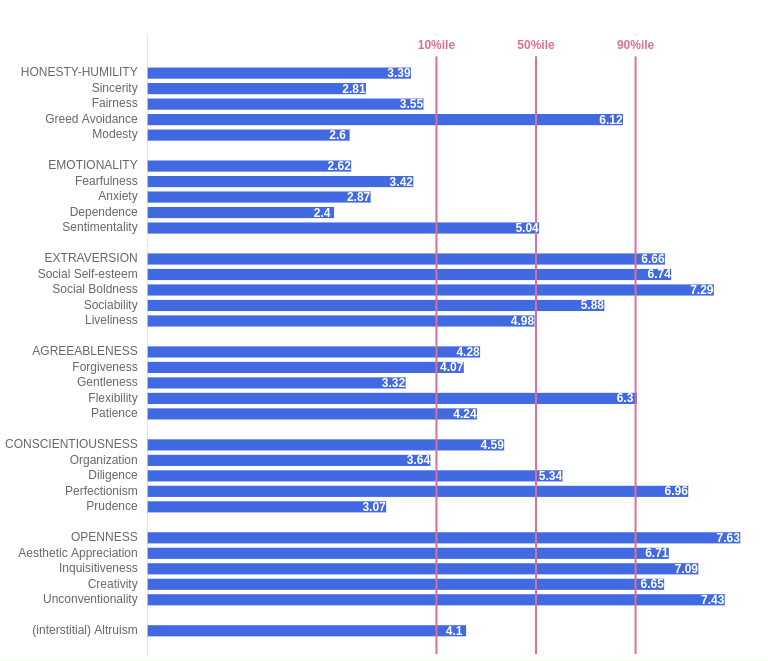
Domain and facet scores are typically reported on a 1–10 scale (higher = more of that trait). The bell curves below show where a score sits relative to the general population distribution. Percentile bands (<10th, 10–50th, 50–90th, >90th) are marked along the horizontal axis.

Read

Books to learn more

  • The H Factor of Personality

    Why Some People are Manipulative, Self-Entitled, Materialistic, and Exploitive—And Why It Matters for Everyone

    The H Factor of Personality explores the importance of the Honesty-Humility (H) dimension of personality in various aspects of people’s lives.

    Kibeom Lee & Michael C. Ashton

  • Individual Differences and Personality

    4th edition

    A comprehensive survey of scientific research on personality and other psychological characteristics.

    Michael C. Ashton

Scale Descriptions

Domain-level and facet-level definitions from the official HEXACO site. Tap a domain to read its facets.

My Results

Scores from the HEXACO Personality Inventory at hexaco.org. Bell curves animate as each chart scrolls into view — red dotted line marks the raw score.

HEXACO Personality Inventory results summary sheet
Open original ↗